What is the Lenox Project?
The Lenox Project, which was founded in 2011, is a charity which intends to build and launch a full-size replica of the Lenox, a state-of-the-art naval ship that was built in 1678 in Deptford and was the first of Charles II’s thirty ships.
Download our short flyer here.
The objects of the charity are:
a) building a replica of the Lenox, a restoration warship, at Convoys Wharf in Deptford and repairing and building other culturally or historically significant vessels in the future;
b) increasing public understanding and awareness of the history of Deptford, the Royal Dockyard, and the area’s contribution to the development of shipbuilding;
c) promoting educational, teaching and employment opportunities through a maritime and manufacturing skills and training programme, and related apprenticeship programmes;
d) establishing a centre of excellence for historic shipbuilding and restoration in Deptford; and
e) launching and sailing the Lenox to support a future programme of sail training
We also want to establish a centre of excellence for historic ship-building, and have a museum of Deptford history at the site, containing some of the many archives that are kept at the Maritime Museum in Greenwich.
The project is based in Deptford, south east London, just a few minutes’ walk from the World Heritage site of Royal Greenwich, to which we are inextricably linked by our maritime roots.
The Lenox campaign came about when developer Hutchison Whampoa, which owns the site of the former dockyard, put forward plans to redevelop the site, largely for luxury housing. There was a strong desire in the local community to see greater recognition of the heritage of the site, and the proposal to bring ship-building back to Deptford is one way of acknowledging the heritage of the site, while creating jobs, training and apprenticeships for the young people of the area.
The potential benefits this project can offer to Deptford, Greenwich, and the developer are enormous. The site’s owner and developer Hutchison Whampoa acknowledged this by formally including the project on the masterplan being put together by Terry Farrell & Partners.
The Lenox Project will be based on the Convoys Wharf site at the riverside in Deptford, within easy walking distance of maritime Greenwich, and the site is also planned to have its own Thames Clipper pier. This will enable the scheme to radically enhance the experience for tourists visiting this part of the Thames. With known visitor figures, we believe the Lenox Project will be self-financing within two years of her keel being laid.
Read our vision document
Watch our short film about the Lenox Project:
Why Deptford?
The year 2013 marked the 500th anniversary of Deptford dockyard receiving its Royal Charter from King Henry VIII and becoming the navy’s premier ship-building yard. Although it was not the largest of the navy’s yards, Deptford remained the most important until ships became so big that launching so far up-river started to be problematic.
Evidence of boat-building on this site dates back to the Romans, but from 1513 onwards, more than 400 naval ships were built here until the yard was closed in the 1860s.
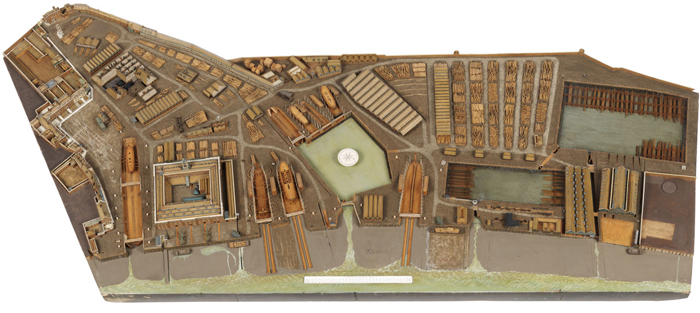
Model of the Deptford Royal Dockyard in 1774 (National Maritime Museum, Greenwich, London)
For many years, this hidden-away 42 acre site has been idle while planners, developers, and others have argued over densities and profit margins. However, beneath the surface of the site, the monumental structures of the entire Royal Dockyard are still in place. As well as the foundations of the dockyard’s Tudor storehouse, substantial remains of the double dry dock, numerous slipways, mast-ponds, and the Great Basin have been unearthed. Above ground at the centre of the site is the listed Olympia boatbuilding shed and just outside the limits of the development is the spectacular Master Shipwright’s House, where John Shish lived.
Why the Lenox?
Deptford’s transformation into the Navy’s premier shipyard came about after Charles II persuaded Parliament to finance the construction of 30 radical new warships, the first of which was Lenox. Named after Charles II’s favourite – and illegitimate – son, the boat was designed and built by master shipwright John Shish, and presided over by Samuel Pepys.
The skills, technology, and industry that were required to build these ships mean that by today’s standards, the best comparison to 17th century Deptford would be Cape Canaveral.
Richard Endsor’s book, The Restoration Warship, catalogues the history and construction of Lenox in minute detail. Using this information, which is drawn directly from records kept by John Shish at the time Lenox was built, it will be possible to construct an exact replica. This will be the first Navy vessel of this period to be built using contemporary records.
Find out more about the history
How long will it take?
Once we lay the keel, we estimate the build will take 7 to 10 years. The ship must be launched before having her masts and cannon put on board, and the intention is for the Lenox to have her home berth at the site. The facilities we build will then continue to be used for refitting historic ships and training local students.
Has anyone else done this?
Similar projects in Europe such as L’Hermione at Rochefort in western France have already proved the success of the concept and have provided employment and training in both traditional and modern transferrable skills. Moreover, in the case of L’Hermione, this has triggered the rejuvenation of the whole town developing hospitality, catering, and the arts as well as other marine enterprises.
Find out more about other projects
Who is leading this project?
The Lenox Project, most of whose members live in Deptford, has spent the last few years steadily researching, campaigning and seeking support. Interest and confidence in the project is growing, with the project gaining its first patron in Dame Joan Ruddock while she was still MP for Lewisham Deptford; subsequently the historian and broadcaster Dan Snow also agreed to act as patron for the cause.
Read more about our members
What have you been doing all this time?
Our first task was to persuade the developer to incorporate our vision on the site masterplan. This was made more difficult when the Mayor of London called the planning application in for determination – having spent a lot of time lobbying our local representatives and planners, we then had to go through the process again with the Greater London Authority planners and representatives.
But at the hearing in March 2014, when he granted planning permission for the scheme, the mayor added a requirement that the developer pay for a study to be conducted ‘to establish the most feasible location on the site for the Lenox’. It took more than a year for the planning process to be completed and the permission to finally be granted, and in June 2015 the feasibility study began. The final report, which identified the protected wharf element of the site as the most feasible for our project, was published in December 2015. Read about the outcome of the feasibility study
What’s next?
The team is actively fund-raising and intends the first tangible manifestation of the project to be the construction of a sizeable scale model as well as a scheme to digitise the plans of the ship. The intention is to involve local trainees and unemployed people right from the early stages onwards.
In January 2017 we completed the process of converting from a CIC (Community Interest Company) to a charity and we are now registered with the Charities Commission. We also started work on drafting our full business plan.
Once the business plan is finished, it must be approved by both the landowner (Hutchison Whampoa) and the planning authority (Lewisham Borough Council) before we can start the process of negotiating a lease for the site.